
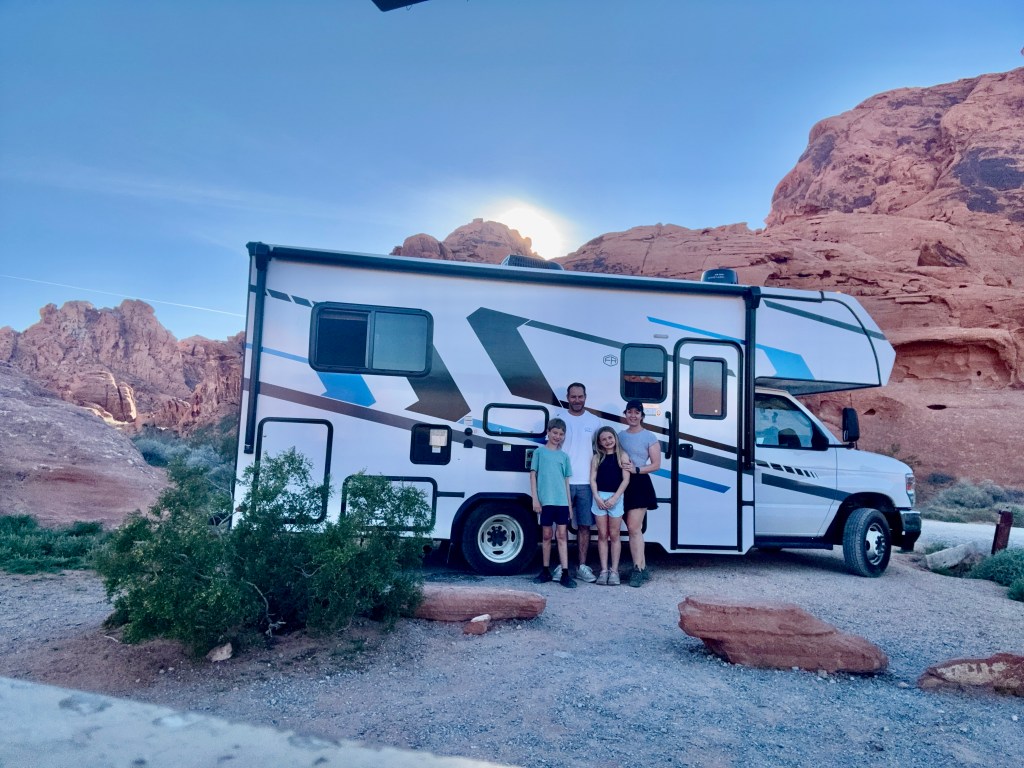
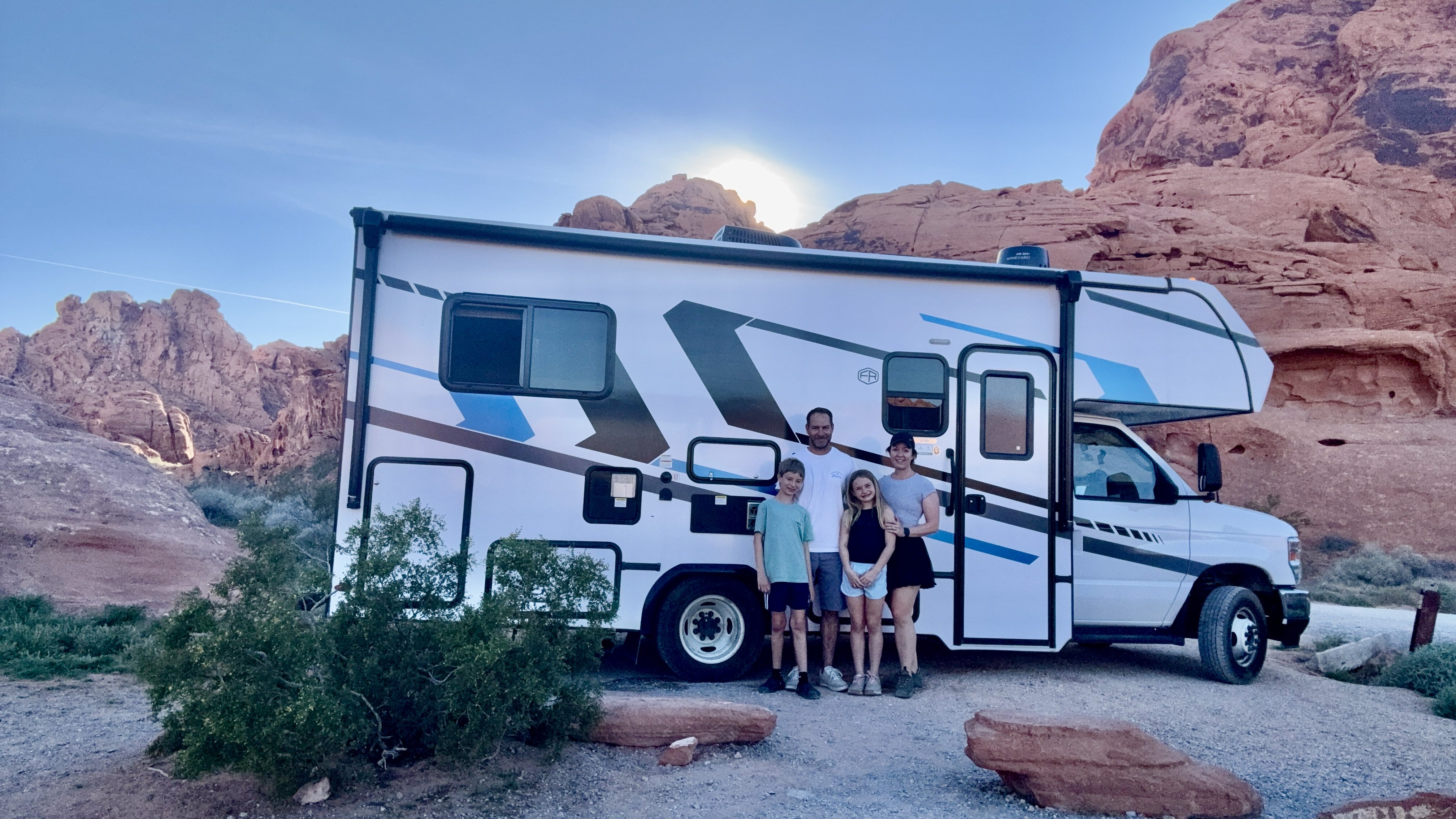
For spring break in March 2026, we flew into Las Vegas, rented an RV and spent more than a week road-tripping through the Southwest as a family. Our route took us through Nevada, California and Arizona, with stops at Death Valley, Joshua Tree, Valley of Fire and Hoover Dam.
It was our first big RV trip and the perfect mix of national parks, desert scenery, campground life and a final night of comfort back in Las Vegas. Here’s the full route, where we stayed and what we learned along the way.
The Trip at a Glance
Our trip lasted from Thursday, March 12 through Friday, March 20.
We flew round-trip through Las Vegas and traveled in a Class C RV from Road Bear RV. We did not have a tow car, so we planned the route carefully and made sure our campgrounds and stops would be manageable with the RV.
Our route was:
Las Vegas → Death Valley → Joshua Tree → Pit Stop Hoover Dam -> Valley of Fire → Las Vegas
The driving distances were long enough to make the scenery feel completely different at every stop, but short enough that we did not lose entire days to driving.
Starting in Las Vegas
We flew into Las Vegas on Thursday evening and landed a little after 9 p.m. Rather than trying to pick up the RV that night, we stayed in a hotel and started fresh the next morning.
That ended up being the right decision. Traveling with kids and luggage is already a lot, and adding an unfamiliar RV after a late flight would have made the first night much more stressful.
On Friday morning, we headed to Road Bear RV on Boulder Highway for our 9 a.m. pickup. We decided on a smaller Class C so we could drive and park it easier. Keep in mind, this was our car for the whole trip so we needed to be able to drive places and park without too much of a hassle.
Tip: We booked an extra day at the beginning of our trip so we could get the early pickup. Otherwise, you can’t pick up until 1 p.m..
After the walkthrough and paperwork, we drove to a nearby Walmart where I had scheduled a grocery pickup in advance. That made it much easier to stock the RV with everything we needed for the week without spending part of our first day shopping. Once the groceries were loaded and everything was organized, we began the drive toward Death Valley.
Days 1 and 2: Death Valley National Park
Our first destination was Death Valley National Park, about two and a half hours from Las Vegas driving an RV.
Death Valley was the perfect place to begin because it immediately made the trip feel like an adventure. The landscape is enormous, open and unlike anywhere else we had traveled as a family.
We stayed at Furnace Creek Campground, Site 45, for two nights. Because of how expansive the park is, you definitely want to stay inside the park to make it much easier to explore without adding a long drive at the beginning and end of each day. From Furnace Creek you can also walk to the Visitor Center and The Ranch at Death Valley.
Tip: You can purchase a pool pass from the reservation desk at The Ranch. There is also a popular ice cream shop and restaurants we enjoyed having so close to the campsite.
It also gave us time to settle into RV life because we were able to secure a site with full hookups. To get the site I had to be on top of my game! I downloaded the apps recreation.gov and Campflare so that as soon as a spot opened up I could book. And you have to be quick! The good spots go fast. I would book a spot and if a better one opened up I’d cancel it for a nominal fee. That was worth it to get the best site possible.
Hikes and spots we did – and recommend!
- Sunrise at the Mesquite Flat Sand Dunes (my favorite!)
- Zabriskie Point (fairly quick stop on your way to/from Furnace Creek)
- Dante’s View (a scenic overlook, we did this on our way into the park from Las Vegas)
- Badwater Basin (there was water in it when we were there, water shoes are recommended)
- Sunset drive through Artist’s Palette
- Mosaic Canyon Trail (the longest hike we did, but loved it!)
- Golden Canyon Trail (busier than Mosaic, we did this before we left on the last day)
- Artists Palette (A one-way drive through, be sure to time sunset. You can do it on your way back from Badwater Basin)
There is a ton of content and blogs on which places to hike and see inside Death Valley. Be sure to research what you want to do and prioritize. Some things you can drive by or through and get out for pictures. While others are longer hikes. And almost everything you have to drive to get to. So map out your time in order to make the most of it.
Days 3 Through 5: Joshua Tree National Park
On Sunday, we left Death Valley and drove approximately four hours to Joshua Tree National Park.
This was one of our longer transition days, but the changing landscape made the drive part of the experience. We went from the wide-open views of Death Valley to Joshua Tree’s distinctive trees, rock formations and giant piles of boulders.
We stayed for three nights at Jumbo Rocks Campground, Site 81.
Jumbo Rocks was one of the campgrounds I was most excited about when planning the trip. The campsites are surrounded by huge rock formations, so the campground itself feels like part of the park rather than simply a place to sleep.
Staying three nights gave us two full days without moving the RV. That was especially helpful because we did not have a separate vehicle. Each time we wanted to explore, the RV came with us, so having a slower schedule made the trip much more enjoyable.
We intentionally kept one of our Joshua Tree days flexible. We considered taking a side trip to Anza-Borrego Desert State Park, which would have been about two and a half hours away, but treated it as an option rather than something we had to fit in.
That flexibility was an important part of the itinerary. It is tempting to add every nearby destination to a road trip, but sometimes having another day to explore, rest or change plans is more valuable than checking off another location.
Joshua Tree also felt like the point in the trip when we had really adjusted to traveling in the RV. We had a better rhythm, knew how long it took to get ready in the morning and had learned that anything left loose would definitely move the second we started driving.
Day 6: Joshua Tree to Valley of Fire
On Wednesday, we left Joshua Tree and headed toward Valley of Fire State Park in Nevada.
The drive was approximately four hours, depending on stops. We considered routing through Palm Springs, but with an RV and a set campground arrival, we kept the day flexible.
We stayed at Atlatl Rock Campground, Site 7, inside Valley of Fire State Park.
Valley of Fire was a great final camping destination. The red sandstone landscape was completely different from both Death Valley and Joshua Tree, which made it feel like we had reached another distinct part of the trip even though we were already heading back toward Las Vegas.
It was also conveniently located about an hour from the city, making the final RV return much easier.
Instead of waking up several hours away and worrying about traffic or a late return, we were close enough to enjoy our last night of camping and still make our 11 a.m. drop-off time the following morning.
Finishing the Trip Back in Las Vegas
On Thursday morning, we drove from Valley of Fire back to Las Vegas and returned the RV to Road Bear by 11 a.m.
We spent our final night at Red Rock Resort before flying home Friday afternoon.
Adding a hotel night at the end of the trip was one of the best choices we made. It gave us time to return the RV without also worrying about catching a flight, reorganize our luggage, take real showers and enjoy one final evening before heading home.
It also created a buffer in case anything went wrong with the drive or RV return.
After nearly a week of campgrounds and desert landscapes, a hotel room felt especially luxurious.
Our Full Southwest RV Itinerary
Thursday, March 12
Fly into Las Vegas
Landed at 9:05 p.m. and stayed overnight near Las Vegas.
Friday, March 13
Las Vegas to Death Valley
Picked up the RV from Road Bear RV at 9 a.m.
Drive time: Approximately three hours
Stayed at Furnace Creek Campground, Site 45.
Saturday, March 14
Death Valley National Park
Full day in Death Valley.
Second night at Furnace Creek Campground, Site 45.
Sunday, March 15
Death Valley to Joshua Tree
Drive time: Approximately four hours
Stayed at Jumbo Rocks Campground, Site 81.
Monday, March 16
Joshua Tree National Park
Full day in Joshua Tree.
Second night at Jumbo Rocks Campground, Site 81.
Tuesday, March 17
Joshua Tree National Park
Flexible day with an optional Anza-Borrego side trip.
Third night at Jumbo Rocks Campground, Site 81.
Wednesday, March 18
Joshua Tree to Valley of Fire
Drive time: Approximately four hours
Stayed at Atlatl Rock Campground, Site 7.
Thursday, March 19
Valley of Fire to Las Vegas
Drive time: Approximately one hour
Returned the RV by 11 a.m.
Stayed overnight at Red Rock Resort.
Friday, March 20
Fly home from Las Vegas
Afternoon flight home.
What Made This Route Work
The biggest advantage of this itinerary was that we stayed at least two nights at most destinations.
Moving an RV is different from leaving a hotel for the day. Before driving anywhere, everything has to be put away, secured and ready for the road. Staying multiple nights gave us time to enjoy each park without constantly breaking camp.
The route also created a natural loop. We did not have to backtrack, and Valley of Fire placed us close to Las Vegas for the final morning.
Starting and ending with hotel nights also made the travel days much easier. We did not have to combine a flight, RV pickup and long drive into one exhausting day, and we did not have to return the RV and immediately rush to the airport.
A Few Things We Learned
Download everything before entering the parks. Cell service was limited in several areas, so having maps, campground details and reservation information saved ahead of time was important.
Pack for changing temperatures. The desert can be warm during the day and surprisingly cold at night. Layers were essential, especially around the campgrounds.
Stock up before leaving Las Vegas. Grocery stores and supplies become much less convenient once you are inside the parks.
Leave some open space in the schedule. Not every day needs a major side trip or a long list of stops. Some of our itinerary’s best breathing room came from having flexible days.
Expect RV travel to take longer. Drive times do not include grocery stops, fuel, bathroom breaks or the extra time it takes to navigate and park a larger vehicle.
Keep a grab-and-go bag ready. We kept a daypack accessible with water, sunscreen, snacks and anything we might need during stops so we did not have to search through the entire RV.
Would We Take This Trip Again?
Absolutely.
This itinerary gave us a mix of national parks, state parks, desert landscapes, campgrounds and a little time in Las Vegas without trying to cover too much ground in one week.
RV travel definitely requires more planning than checking into a hotel, but it also allowed us to stay in the middle of some incredible places and experience the trip at a different pace.
It felt adventurous without being completely overwhelming, and it gave us the kind of family memories that are usually found somewhere between the big destinations and the everyday moments along the way.
Which feels like the perfect place to begin Everywhere & At Home.

 Everywhere & At Home
Leave a comment